
Car Park Ventilation Fire Safety: A Design Guide for Enclosed & Underground Car Parks
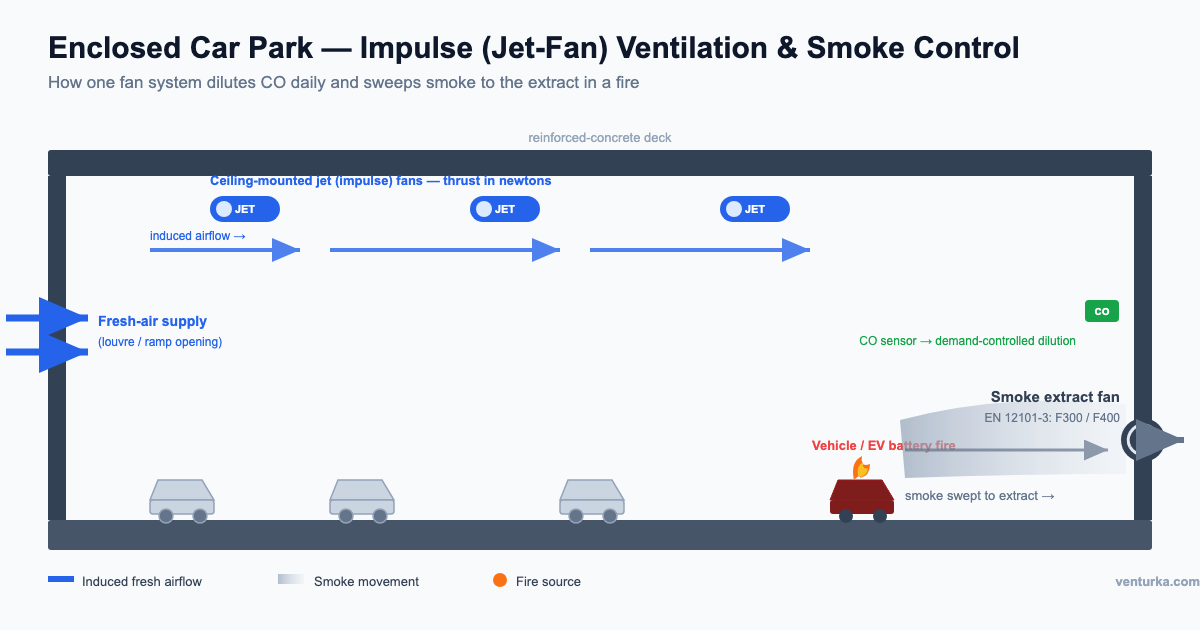
Car park ventilation fire safety keeps an enclosed or underground car park breathable day to day and defensible during a fire, using one fan system that switches between two jobs. In normal use it dilutes vehicle exhaust and carbon monoxide (CO); on a fire signal it drives smoke toward the extract points so the fire service can approach the fire and, where the strategy demands, to protect escape routes. Done properly, car park ventilation fire safety is a code-driven task, governed in Europe by the EN 12101 series and BS 7346-7, and turning on fan temperature class, air-movement logic, jet-fan thrust and the controls that tie them together.
Key takeaways
- One fan system covers two duties: everyday carbon-monoxide dilution and emergency smoke control.
- In Europe this is governed by the EN 12101 series (F300/F400 smoke fans) and BS 7346-7.
- Jet-fan (impulse) systems suit most modern enclosed & underground car parks; ducted suits legacy or architectural cases.
- Jet-fan layouts must be proven by CFD, and smoke fans need an accredited fire-rating test report.
Why enclosed and underground car parks are a fire-safety problem
An enclosed car park has almost none of the natural ventilation an open deck relies on, so combustion gases have nowhere to go without mechanical help. The everyday hazard is carbon monoxide — a colourless, odourless gas that accumulates in low, poorly circulated basements. The emergency one is a vehicle fire, and increasingly an electric-vehicle battery fire, which can burn intensely and reignite. Because smoke is what blinds and disables occupants, the fire priority is to move it away from where people and firefighters need to be — so the ventilation is life-safety equipment, not comfort plant.
Two duties, and two emergency objectives
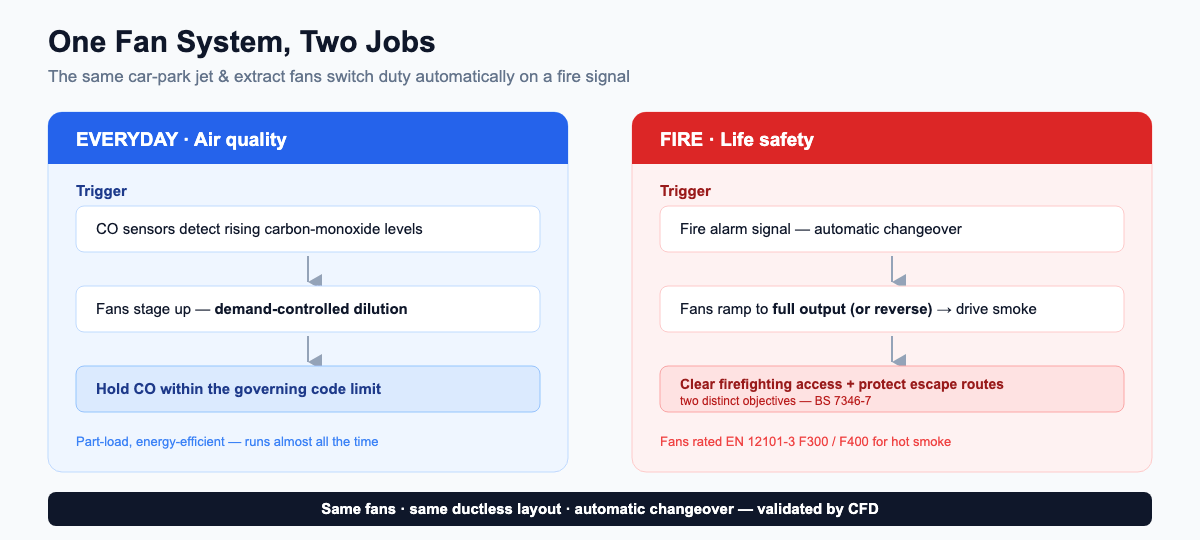
One system covers a daily CO / air-quality duty — demand-controlled dilution triggered by CO sensors, holding concentrations within the limits set by the governing building or civil-defence code — and an emergency smoke-control duty, where a fire signal ramps the same fans to full output (or reverse) to move smoke to the extract points. The emergency case has two distinct objectives often wrongly treated as one. BS 7346-7 separates smoke clearance for firefighting access — keeping the approach path clear near the fire — from smoke control to protect means of escape, the more demanding case that drives higher extract rates, throw calculations and computational-fluid-dynamics (CFD) sign-off. Establish which objective (or both) applies before sizing.
The standards that govern car park ventilation fire safety
Compliance is where car park ventilation fire safety is won or lost: the authority having jurisdiction — a building-control body, fire consultant, or Gulf civil-defence authority — signs off the strategy against named standards. Confirm the exact edition and any local amendment (national annexes, or civil-defence codes in the UAE, Saudi Arabia and Qatar) before finalising.
- EN 12101 series — the European family for smoke and heat control. EN 12101-3 classifies powered smoke exhaust fans by temperature and time as F-classes, such as F300 (300 °C) and F400 (400 °C for 120 minutes).
- BS 7346-7 — the British code of practice giving functional recommendations and calculation methods for smoke and heat control in covered car parks, covering natural, ducted mechanical and impulse (jet-fan) systems. It is the primary UK reference.
- CE marking — the route to place fans on the EU/EEA market, with EN 12101-3 as the harmonised standard for smoke exhaust fans.
Two procurement points. First, a smoke fan’s fire rating is only credible if it is backed by an independent test report from an accredited laboratory — that report is what a consultant submits for approval, so ask for it early. Second, jet-fan layouts should be validated by CFD, not rules of thumb, because the fan count and positions that actually move smoke depend on your geometry, beam depths and exhaust locations. (ATEX rating is separate and applies only where a classified explosive atmosphere exists — for example LPG-vehicle areas or an adjacent fuel store — not to general car parking.)
Jet-fan (impulse) ventilation versus ducted systems
There are two main ways to move air through an enclosed car park, and the choice shapes cost, headroom and how the fire strategy is proven. Ducted systems distribute and extract through ducts and grilles. Impulse or jet-fan systems dispense with most of the ductwork: compact induction fans under the soffit push air in a designed direction, sweeping the floor plate toward main extract fans. Axial jet fans give a strong directional throw for open plates with adequate soffit height; radial jet fans discharge laterally and suit low or beam-interrupted ceilings. Both are selected on rated thrust (in newtons), the parameter CFD uses to confirm how many units, and in what pattern, move smoke to the extract points. Venturka’s jet fans and smoke-extraction range covers both approaches; the table compares them on the criteria that usually decide a project.
| Criterion | Jet-fan / impulse system | Ducted extract system |
|---|---|---|
| Ductwork | Minimal — induction fans move air directly | Extensive supply/extract ducting and grilles |
| Clear headroom | Better — few or no large ducts | Reduced by duct runs; tight in low basements |
| Design validation | CFD strongly recommended | Air-movement calculation, duct balancing |
| Smoke-control flexibility | High — fans re-sequenced toward the fire | Largely fixed by duct routing |
| Low-soffit / beamed spaces | Radial jet fans suit constrained throw | Often hard to route ducts |
| Typical fit | Most modern enclosed & underground parks | Legacy layouts, architectural cases |
Sizing, air movement and CO control logic
For everyday air quality, modern best practice is demand-controlled CO ventilation: sensors stage the fans up as concentrations rise, so the air-change rate is an outcome of holding the CO limit, not a fixed target. An older rule of thumb of around 6 air changes per hour (ACH) is still quoted as a fallback, but many codes — including Gulf civil-defence guidance — size on CO concentration or airflow per car space instead. For the fire case the extract rate is higher, derived volumetrically from the design fire and the CFD model; BS 7346-7, for instance, references a high exhaust rate on the fire-affected level. These figures are typical or approximate; exact rates, ppm trip points and alarm levels are set by the governing code and local authority. In Gulf and desert projects, high ambient temperatures and basement heat soak raise the baseline, so components should be rated for the local ambient with the fire class holding on top — and where a car park sits beneath occupied floors, containing smoke to the parking level matters more still.
Integrating detection, controls and the smoke strategy
The fans are only as good as the logic that drives them. An automation panel reads the CO sensors for daily ventilation and the fire-detection or building fire-alarm system for the emergency mode, then drives fans and motorised dampers to a pre-agreed scenario. On a confirmed fire signal it overrides normal running, brings the smoke fans to full duty, and sequences jet fans along the path the CFD model assumed. Life-safety operation also needs fire-rated cabling to the smoke fans, a clear fire-alarm cause-and-effect interface, manual override for the fire service, and commissioning that verifies the as-installed sequence — with periodic function tests (commonly weekly for smoke systems, as set by the maintenance regime) keeping it reliable after handover.
Design and procurement checklist for car park ventilation fire safety
- Confirm governing standards and local amendments — EN 12101 series, BS 7346-7, any national annex or Gulf civil-defence code — with the authority first.
- Fix the emergency objective: firefighting access, means-of-escape protection, or both — it drives the extract rate.
- Fix the two duties: daily CO-demand ventilation and the emergency smoke-control rate.
- Require a CFD study for jet-fan count, position and thrust on the actual geometry.
- Specify the smoke-fan temperature class (for example F400) with an independent fire-test report to EN 12101-3.
- Choose axial or radial jet fans to soffit height and beam depth; radial where throw is constrained.
- Rate equipment for local ambient — critical in high-temperature Gulf and desert projects.
- Design the control philosophy: CO staging, fire-mode override, cause-and-effect, fire-rated cabling, fire-service manual control.
- Plan commissioning, periodic testing and the documentation pack (certificates, test reports, CE and any ATEX).
Frequently asked questions
Which standards apply to car park ventilation fire safety?
In Europe the EN 12101 series governs smoke and heat control, with EN 12101-3 classifying powered smoke exhaust fans by temperature and time as F-classes (for example F400). BS 7346-7 is the UK code of practice for covered car park smoke ventilation, covering ducted and impulse systems. Local amendments and civil-defence codes — including in the Gulf — must be confirmed with the authority.
Do I need CFD analysis for a jet-fan car park system?
For impulse (jet-fan) systems it is strongly recommended. CFD confirms the chosen number, position and thrust of fans actually moves smoke to the extract points for your specific geometry, beam depths and exhaust locations. It is also the evidence many approving authorities expect, especially where the objective is protecting escape routes rather than firefighting access.
What fire rating should a car park smoke fan have?
It depends on the fire strategy and governing code, but a common class for car park smoke-extraction fans is F400 (400 °C for 120 minutes) to EN 12101-3, verified by an independent test report. Confirm the exact temperature and time class your consultant specifies; a lower class such as F300 may suit some strategies.
Does an enclosed car park need ATEX-rated fans?
Not normally. A standard petrol, diesel or EV car park is not a classified explosive atmosphere, so ATEX does not generally apply. It is relevant only in specific cases — such as designated LPG-vehicle parking or an adjacent fuel store — where the atmosphere is formally classified.
Conclusion
Sound car park ventilation fire safety comes from treating one system as two duties — daily CO control and emergency smoke control — with the emergency objective defined up front, sized to the governing standards, validated by CFD, and backed by independent fire-test evidence. If you are specifying an enclosed or underground scheme, explore Venturka’s car park ventilation and fire & smoke fan range — with EN 12101-3-classified smoke fans and independent test reports — or contact our engineering team to match the right jet fans and smoke-extraction class to your project. Projects that also need tunnel ventilation can see the tunnel jet fan range.
For stairwell or lobby pressurization, browse the pressurization fan range, or find more engineering guides on the Venturka blog. For the fundamentals behind the fans themselves, start with our guide to axial ventilation fans.
Frequently asked questions
Do open-sided car parks still need mechanical ventilation?
A genuinely open deck with enough free area on opposite sides can often rely on natural ventilation, but any enclosed or underground level — or a deck that fails the free-area test — needs a mechanical system. The authority having jurisdiction confirms which case applies.
Are jet fans cheaper than a ducted system?
Impulse (jet-fan) systems remove most ductwork, which usually lowers installation cost and preserves headroom — a common reason they are chosen for modern car parks. The trade-off is that the layout must be validated by CFD rather than a simple duct calculation.
Do I need F300 or F400 smoke fans?
The required temperature class comes from the fire strategy and the governing standard for the project, not a rule of thumb. EN 12101-3 defines the classes (for example F300 at 300 °C, and F400 at 400 °C for 120 minutes); the fire consultant specifies which the design demands, backed by an independent test report.
Does an electric-vehicle fire change the design?
EV battery fires can burn intensely and reignite, which raises the importance of reliable smoke control and the fan fire rating. Confirm the current civil-defence or building-control guidance for EV parking in your market, as requirements are evolving.
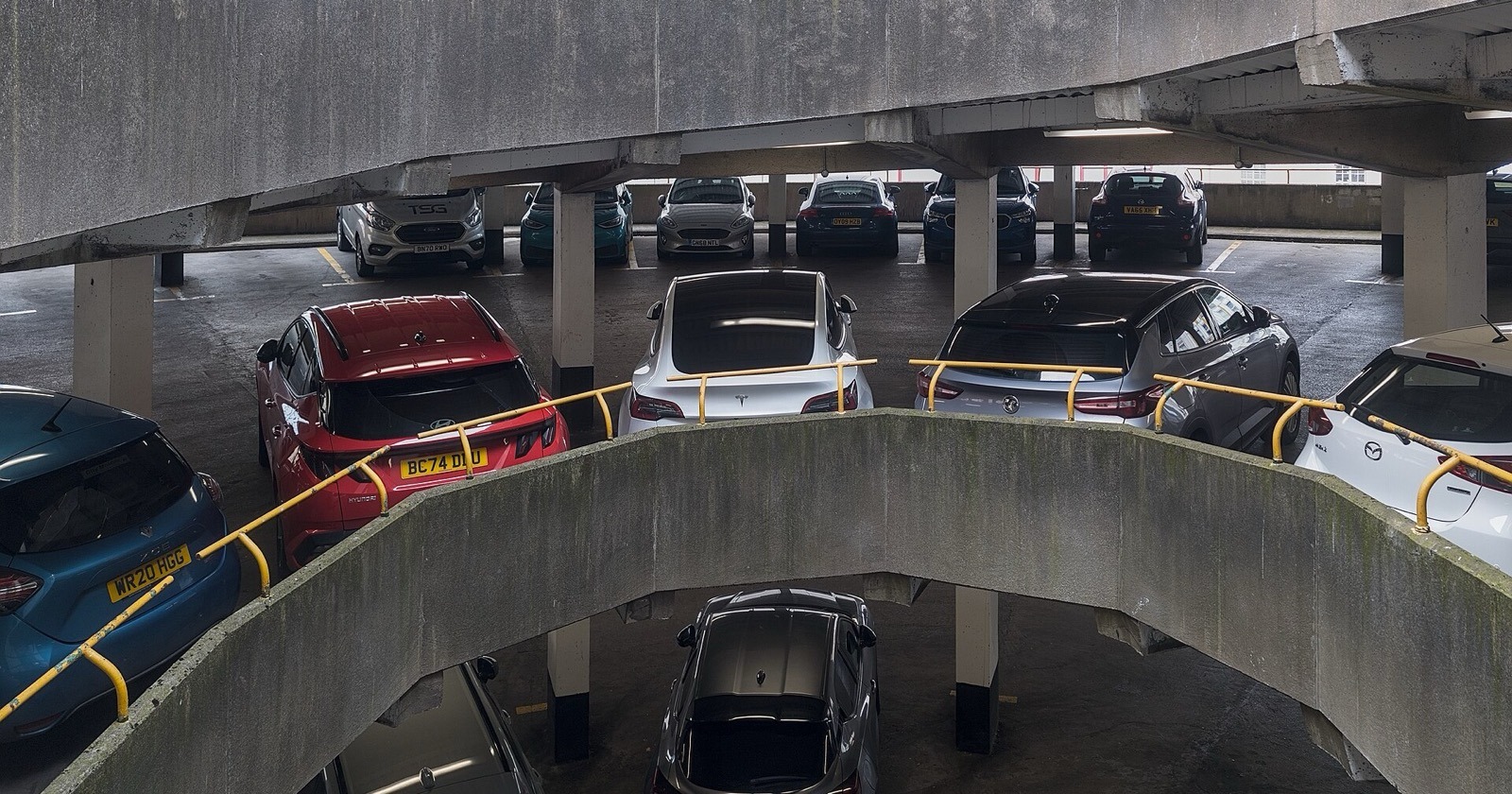
Header photo: enclosed multi-storey car park by Tadeusz Hare, CC BY-SA 4.0, via Wikimedia Commons.